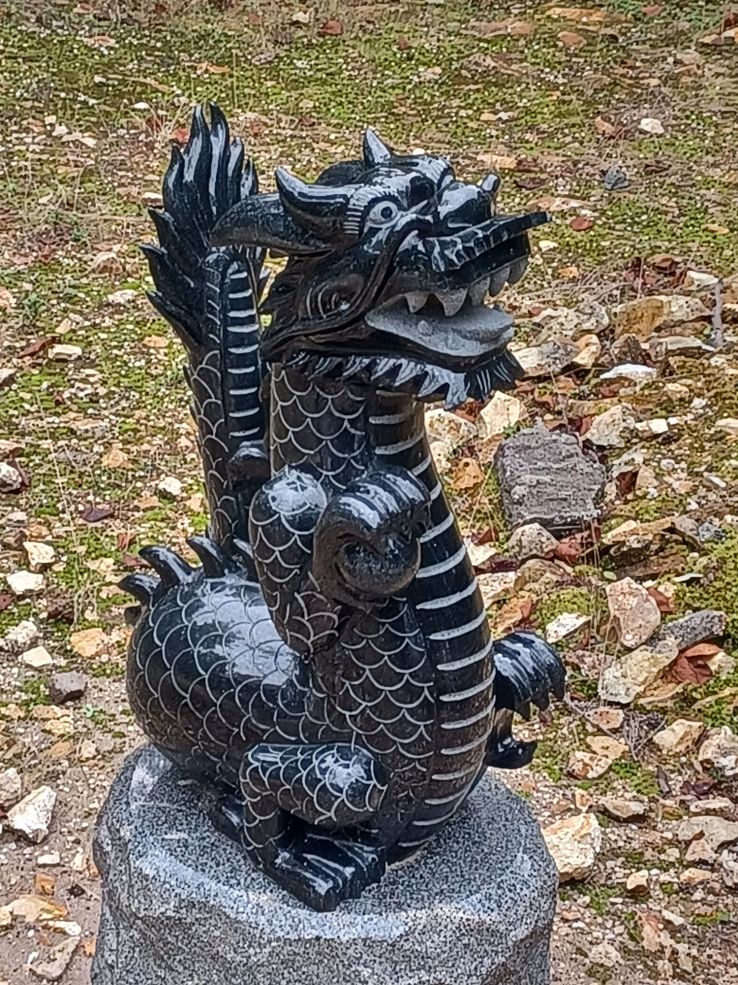
I’ve decided I like dragons, the Japanese version without the English wings. They are terrifying and cool.
I don’t know what’s up with putting hats on carved figures, but the Santa hat was a bit much. And, “he” doesn’t look too amused either.
I asked this woman for directions in Izumozaki. While being able to understand very little of what she said, she did make it known that she would take me where I wanted to go. So, we walked a long way together. Then, a car pulls up to us on a narrow street. She had apparently sent her brother a message and he came to pick us up. I’m beginning to think that this is not such an unusual thing to happen in this very hospitable country.
Not something seen often in America. This is a humongous statue of “Kannon,” a deity of compassion much beloved in Japan.
Community self-promotion poster seen in Eihei-ji, a center of Zen Buddhism in the world. I guess I can’t blame the town officials for capitalizing on their celebrity temple. And, yes, I do feel it.
Finally, my poor hat. In the space of an hour I left it behind three different times. I had to run back along the road until I spotted it lying there. This was only the second time. I didn’t know about the third time until, after having had my coffee at a nice little place in Eihei-ji, I walked quite a ways to the bus station. I heard shouting behind me. I turned to find a woman from the coffee place running down the street carrying my hat. Out of breath, she smiled happily, bowed, and made her way back to the shop. Will these kindnesses never cease?
In any of our spiritual traditions, there are those who inspire us to continue in the Way. In the best of spirituality given me in my Christian path, I will name one – Francis of Assisi. In my spiritual path now, there is this one, not unlike Francis. He is Ryōkan – Zen Priest, hermit, poet, master calligrapher.
I rented a car in Niigata and drove 60 km down the western coast of Japan to see his birthplace in Izumozaki and then to the Tsubame area to see where he spent many years living alone in a small hut – Gogoan. I did this because I’ve read many of his written works, mostly poems in a Japanese style, and discover in them, as many have, evidence of a life lived in utter faithfulness to the spiritual traditions he received from his Buddhist ancestors.
As with many inspiring religious figures, including Francis, Ryōkan did not follow a usual path. That path would have had him become ordained and then spend the rest of his career caring for a temple somewhere in Japan – an entirely honorable way of life.
He chose to step off this path. He wandered for years as an itinerant monk, no one quite knows where his travels took him. Then, for many years he lived as a hermit, alone, in a small hut and walking with his ringed staff and begging bowl to obtain what townspeople would offer him.
He was friend to farmers, enjoying spending an evening with them drinking sake.
Midsummer -
I walk about with my staff
Old farmers spot me
And call me over for a drink.
We sit in the fields
Using leaves for plates.
Pleasantly drunk and so happy
I drift off peacefully
Sprawled out on a paddy bank.
He was especially friends with the children, spending hours playing a ball game with them in the streets. They would flock to him.
First days of Spring - the sky
is bright blue, the sun huge and warm.
Everything's turning green.
Carrying my monk's bowl, I walk to the village
to beg for my daily meal.
The children spot me at the temple gate
and happily crowd around,
dragging at my arms until I stop.
I put my bowl on a white rock,
hang my bag on a branch.
First we braid grasses and play tug-of-war,
then we take turns singing and keeping a kickball in the air:
I kick the ball and they sing, they kick and I sing.
Time is forgotten, the hours fly.
People passing by point at me and laugh:
"Why are you acting like such a fool?"
I nod my head and don't answer.
I could say something, but why?
Do you want to know what's in my heart?
From the beginning of time: Just this! Just this!
At the end of the day he would retreat to his hut up in the hills, and practice zazen in the manner prescribed by Master Dogen. There, he suffered from poverty, hunger, cold and snow in winter, summer heat, and sickness.
No luck today on my mendicant rounds;
From village to village I dragged myself.
At sunset I find myself with miles of mountains between me and my hut.
The wind tears at my frail body,
And my little bowl looks so forlorn -
Yes this is my chosen path that guides me
Through disappointment and pain, cold and hunger.
Read his writings, though, and you will find one completely in wonder at the natural world surrounding him – the flora and fauna of abundant life. I sense, even through his suffering, a joy in life until the end.
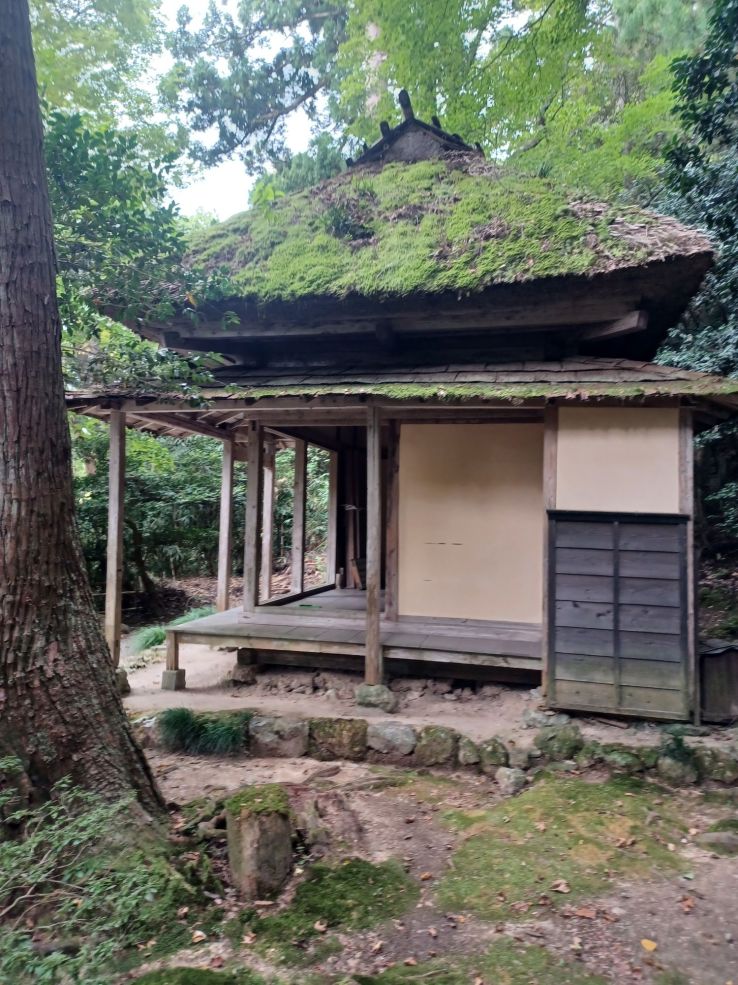
Gogoan. Not the original but a replica in the place where it stood on the grounds of Kotokuji temple.
Above Izumozaki, on the coast of the Sea of Japan, his birthplace. Note, that I caught a dragonfly in flight. Unintended, but sometimes that happens!
Several months ago I listened to an audio book called, “Water, Wood, and Wild Things,” by Hannah Kirschner. She is an American who came to Yamanaka and spent four years befriending the local craftspersons. Her book, telling of the people here and the crafts created here, inspired me to want to make Yamanaka a part of my trip.
Yamananaka is a small mountain town that is not well known to foreign tourists. Had I not listened to the book, I would not be here. So glad I came!
My two full days here could not have been more different. Yesterday, it rained buckets almost all day, and I mean big buckets! I took the bus into Yamanaka, which is a short bus trip from where I am staying and spent the afternoon holding an umbrella against the wind and the rain. I got soaked and was cold. There were few people on the streets and it looked every bit of gloomy and deserted.
Today felt like the real first day of autumn in Japan. It was sunny, clear, cool, and windy. Yamanaka was brimming with life.
I walked the streets and along the beautiful pathway by the Daishoji river running through the Kakusenkei gorge.
That would have been pleasure enough – the town, the weather, the people. Then, as I am interested in woodworking, I looked up the wood carving craftspersons and found one who was offering to allow people to turn their own bowls, with help, of course. To my surprise, I found Mr. Sato at Mokume who had a slot open in the afternoon. I walked to his shop, which happened to be across the street from where I was Google searching, and he let me know that I could, indeed, come back a bit later and do the work. I was delighted!
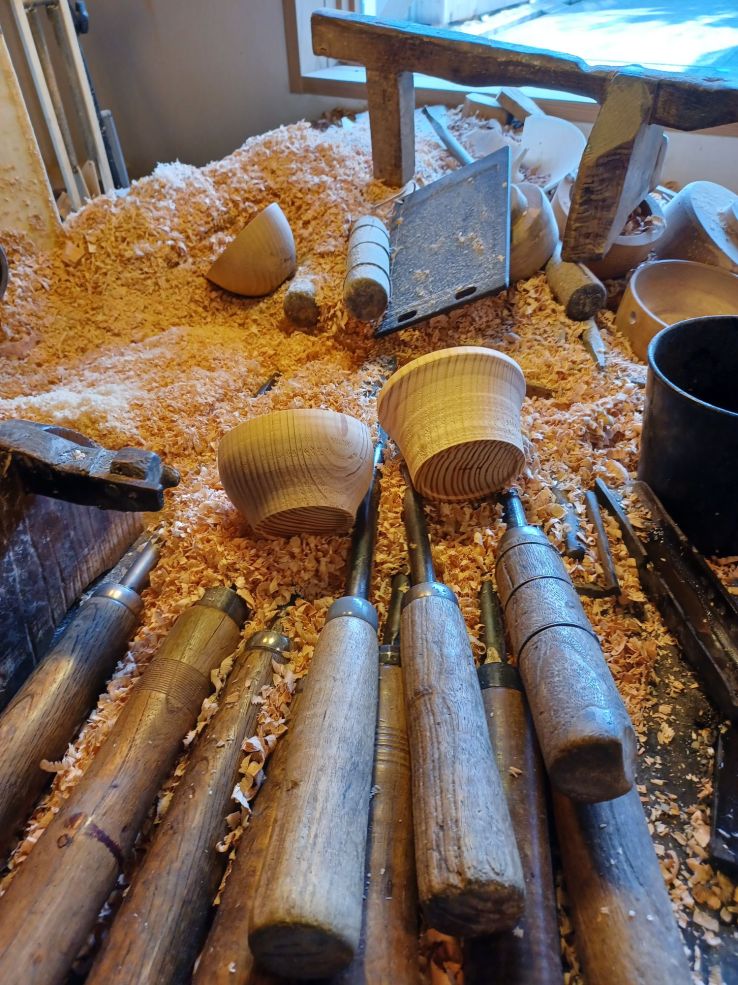
We agreed on the bowls that I wanted and we began the work. Truthfully, he guided me in using the lathe tools but, still, for the three bowls, I had a hand in shaping them and that will always be in my memory when I see them.
This would be my own hand getting ready to be a wood turning craftsman. It was great fun feeling the turn of the lathe beneath the blade of the tools. Working with wood is always such a pleasure. While I’ve never done this kind of wookworking before, I still felt the pleasure of the look, feel, and smell of the wood; the shavings flying off and creating more of a pile on his floor.
This video shows how the “blanks” start out before carving down starts. Also, nice to see a craftsman at work. Though, this is probably the simplest thing in the world for him.
These two beginnings of bowls are “my” creation. One more to go. But, full disclosure, Mr. Sato will do the real work of carving out the inside of the bowls, hand-sanding, and applying the finishing coatings. This will take a few months to complete and then he will send them to me in Seattle. For a bit of cost, it also saves me having to carry them around Japan for the next seven weeks.
Here are my three bowls. Actually, the smallest one is hardly a bowl but will be more of a small tea cup.
Mr. Sato, the craftsman, in his shop.
Part of the jumble.
I will leave Yamanaka tomorrow with fond memories. It is small town Japan, off of the tour bus routes, and happily accessible for those with the inspiration to add it to their itinerary to a land that is becoming less imagination and more reality.
The hospitality continues to amaze and delight me.
I found a small coffee shop in Yamashiro Onsen. Upon bringing my coffee, I was also brought a wheat bun that I am not able to eat due to allergy. I had to bring it back with both my thanks and apologies.
Moments later, here comes a banana! Smiles all around!
Night at Eihei-ji. Full moon. Zazen silence, stillness. Chanting morning service with shaven-headed monks. Steady beat of mokugyo. Large bell sound. Small bell sound. Large drum sound. Incense offering. My wife I thought of as I touched the offering to my forehead before dropping it on the burner. Sweet sacred fragrance rising into old rafters.
Meals in silence from small lacquered bowls. Forgetting – points of chopsticks to right or left? Wondering what these dishes were that I was eating or trying to eat. Salted plum I hope I will not have to eat again. Why would a plum be salted anyway?
Memories of old Dogen floating in the air. Long scroll of the Fukan zazengi, brushed by the Master himself. This, my most memorable sight.
Ancient and sacred corridors, steps, gnarled trees, fountains, river rush, stone, Buddhas and Bodhosatvas meandering. Gorgeous, wonderfully diverse forests rising in every direction, swallowing up Eihei-ji as a dragon would any mindless creature.
Thoughts as I sit with coffee before boarding the bus leaving Eihei-ji.
Here I am at Eihei-ji monastery, the mothership of Soto Zen Buddhism. It is very warm on this full moon day. What could I do when, just outside the entrance, they were tempting me? I could have resisted. I blame the monks here. They made me wait for my room, so here I am.
I am in a sort of resort hotel in the hills above Fukui. I had not realized how isolated it was from any other diversion. Last night I was considering what to do today. This morning, as a nice gray and drizzle has taken over the sky, I realized (duh!) that taking a day of rest would be not only a good idea but a needed idea.
Travel can be exhausting, especially when adding in the complications of language barriers and cultural differences. Therefore, I resolve today to do as most people here do.
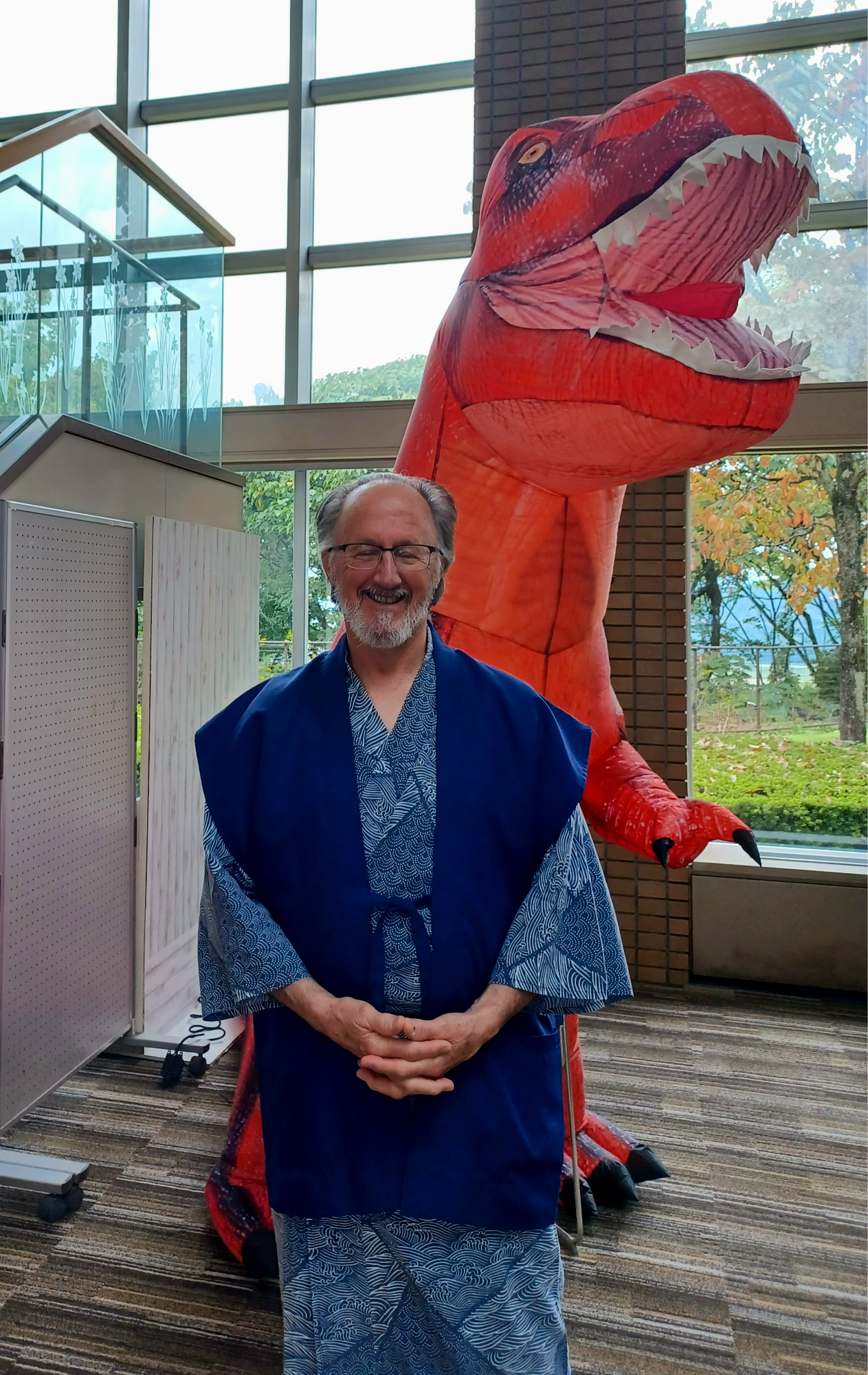
During the day, including at breakfast and dinner, they wear their yukata (long and light cotton robe) and slippers. For warmth or style, the haori is added. I will feel self-conscious wearing these as if to think that everyone will be looking at me. Vanity of vanities.
So, here I am with T-Rex as dinosaurs seem to be a REALLY BIG Fukui thing. He has given me the ferocious courage to step out of my room into the world where people will see me. Aghast!
After today, trains and buses will begin again. All good destinations await but today is, for me, a pause, an interlude, a rest.
I am not one to post food pictures as I am not any sort of foodie and food topics do not interest me. That said, since I am allergic to wheat and get ill if I eat shrimp, I have to be concerned about what I eat, especially here in Japan where wheat products (breads, soy sauce) are pervasive.
I am here at the Kamenoi Hotel in the hills above Fukui. They serve a set menu for dinner, and I did not tell them beforehand about these issues of mine. My grievous fault! I did not know what the set menu was. I went to dinner knowing I would not be able to eat everything set before me. Instead, I could not eat ANYTHING set before me.
I apologized profusely as a large plate of crab was brought to my table, and told the server I would not be able to eat it. I told him I would be happy to pay for the meal anyway since that is what I chose when I reserved the room months ago. I expected no substitutions as was made clear when I checked in.
The server asked me for a little time. In a little time, plates of various foods began to appear all looking and tasting as if long prepared especially for me! The serving and meal preparation staff went out of their way to make sure I was taken care of and happy.
This is one exceptional example of the hospitality and kindness I have been experiencing in Japan.
I feel certain that my Zen brothers and sisters will appreciate this rather unusual view of Master Dogen, perhaps the last sight I might have expected to encounter in Japan or anywhere else in the world for that matter.
For those not acquainted with him, Dogen was a Japanese Buddhist monk who, after some years in China, brought back to Japan the understanding of Zen as we practice it now. His was a towering intellect revealed in voluminous writings, often incomprehensible in translation. These were informed by his rigorous sitting practice (zazen) and a profound enlightenment experience. The Japanese Soto Zen tradition comes from Master Dogen. Near Fukui, where I am off to today, he founded Eihei-ji monastery in 1244. It is the principal center of Soto Zen Buddhism in Japan, or the world. More to come on that later.
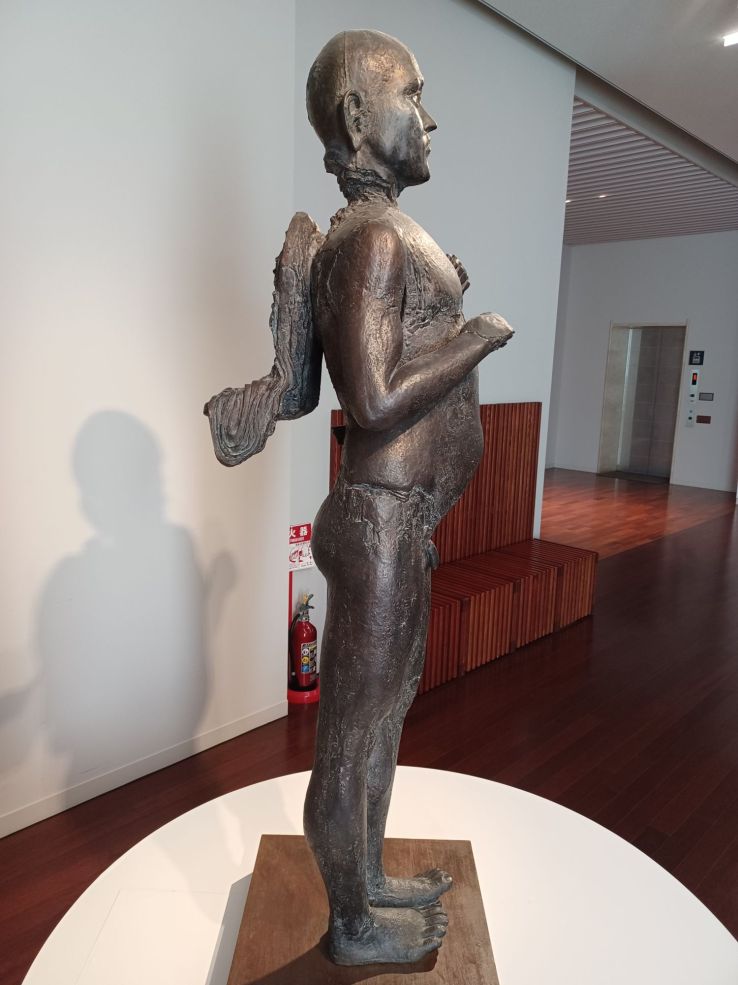
Perhaps this provides enough context for the unusual presentation of Dogen that I encountered in the Matsumoto Museum of Art, as envisioned by Matsumoto born artist, Hosokawa Munehide.
It is interesting to try to imagine why the artist chose Dogen as a sculpture subject, one of several in his “Man and Woman “series. Of these, only the sculpture of Dogen is shown in the museum.
Apparently, the artist’s intent was, so to speak, “strip” the subjects of the veneer created by history and imagination, and present them in their most natural form. Here is Hosokawa Munehide’s interpretive sculpture of Zen Master Dogen, one of the most revered figures in Japans history. (Bronze with glass eyes.)
Frogs are a very big deal in Matsumoto. Here are a couple of dangerous looking Samurai frogs.
I’m not sure what these Swiss alpenhorns are doing in Matsumoto.
Saw this stern looking gentleman at the Soto temple in Matsumoto. I believe he is a representation of Bodhidarma, a monk who brought Chan (Zen in Japanese) to China.
Some of my more knowledgeable Zen friends may know who this figure represents.
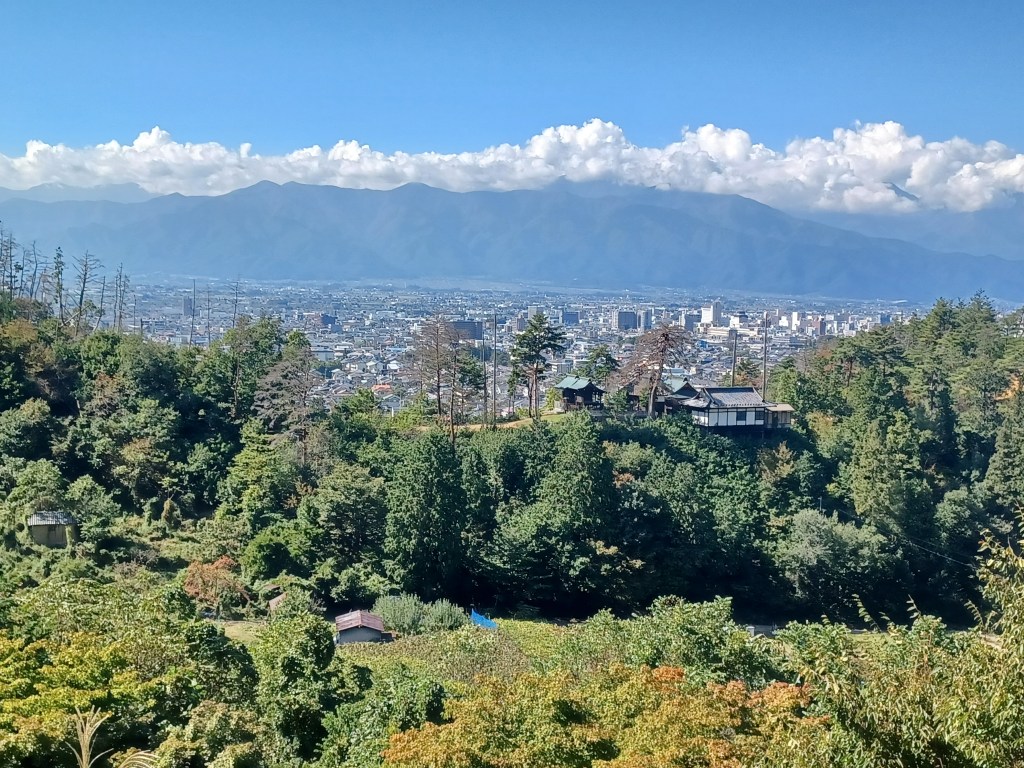
View of Matsumoto city from the temple height.
I just liked the partial moon in this big stone lantern.











 Autumn In Japan