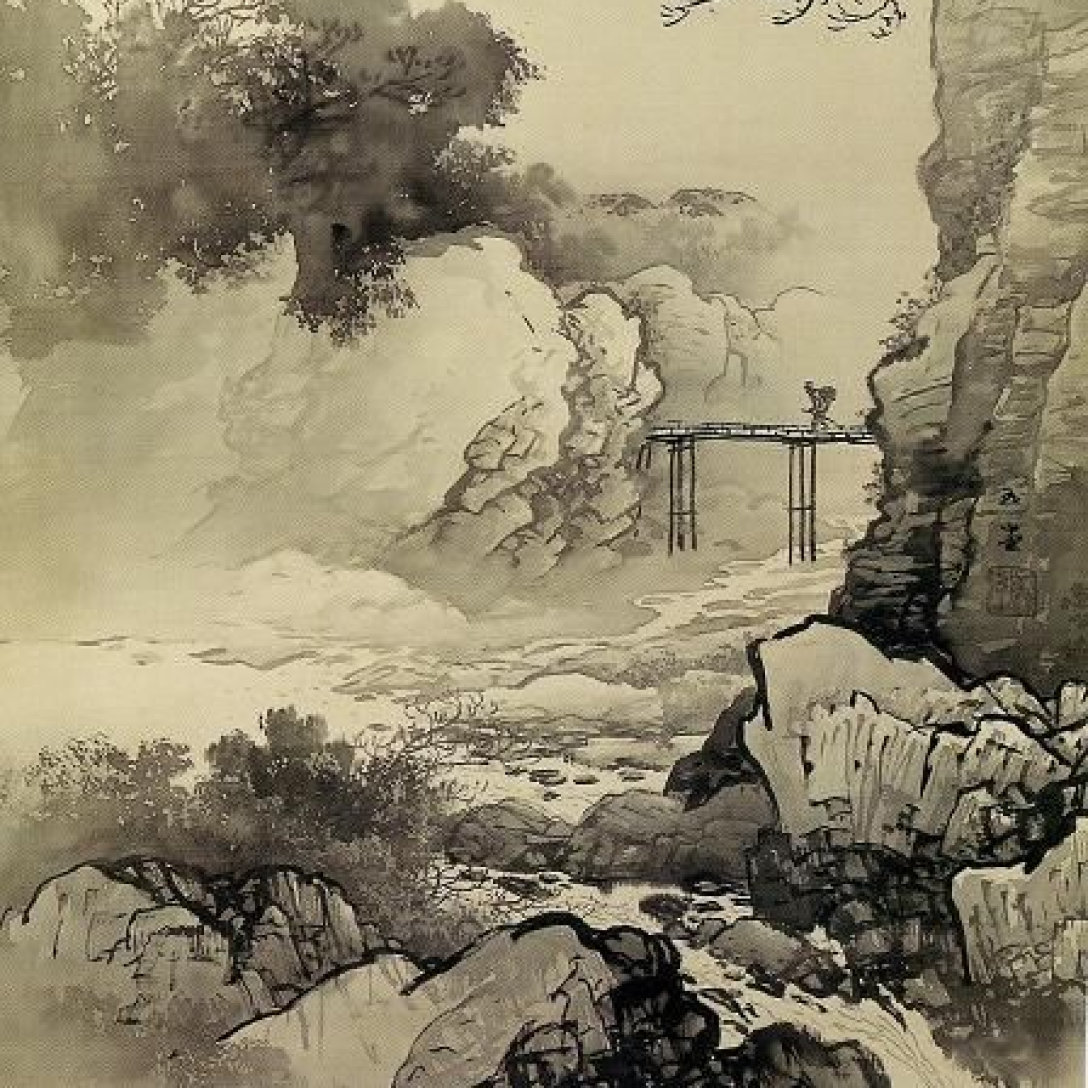

This is a representation of Avalokitishvara at Kosho-ji. He (she?) figures in what I specifically went to Kosho-ji to do.
First, Kosho-ji. The original, in Kyoto, was a significant Soto zen temple because it’s founder was Master Dogen, in 1233. It is the first zen monastery he established after coming back from China where he was greatly influenced by his Chinese zen (chan) teacher. While this Kosho-ji is not at the original site where it was founded by Dogen, it bears his imprint and legacy. It is located in Uji, built long after Lady Murisaki’s great work. It is interesting that in those last chapters of “the Gengi” a small Buddhist monastery has a role to play. Enough of that. They are absolutely not related, in any way whatsoever.
Kosho-ji was the most important reason for my Uji visit. I wanted to visit this place that recalls Dogen’s earlier monastery establishment. It is a Soto lineage zen temple. Dogen was never here, but monks who practice in the manner that he prescribed live here, practice here, and work here.
I met one of those monks this morning. He was working at the reception desk when I arrived, at opening time. I asked if I would be able to copy a sutra, specifically, the “Heart Sutra.” This is a thing they offer guests to do, on their website. There, they indicate that it is best to contact them in advance to reserve a time to do this. I contacted them many weeks ago. Nothing. I texted them several days ago. Nothing. I tried calling. No answer. So, I just showed up this morning. I told this good monk that I wished to copy the sutra. He managed to let me know that I could not do this “at this time.” OK. I expected something like this. So I asked, through Google Translate, whether I could do it later or even on another day? Our verbal, or Google translation skills, were not working. I sensed some frustration on his part, betraying his very human qualities, such as I have, though I try my best to hide them behind a mask of calm control. Foolish that I am.
He stepped up from behind the partition separating us, and came out to where I stood. He motioned for me to follow him. I did.
We walked down a few corridors in our slippers. He slid open a shoji screen to reveal the small room where surtra copying took place. He pointed to a place to sit and left me to figure out how to copy a sutra.
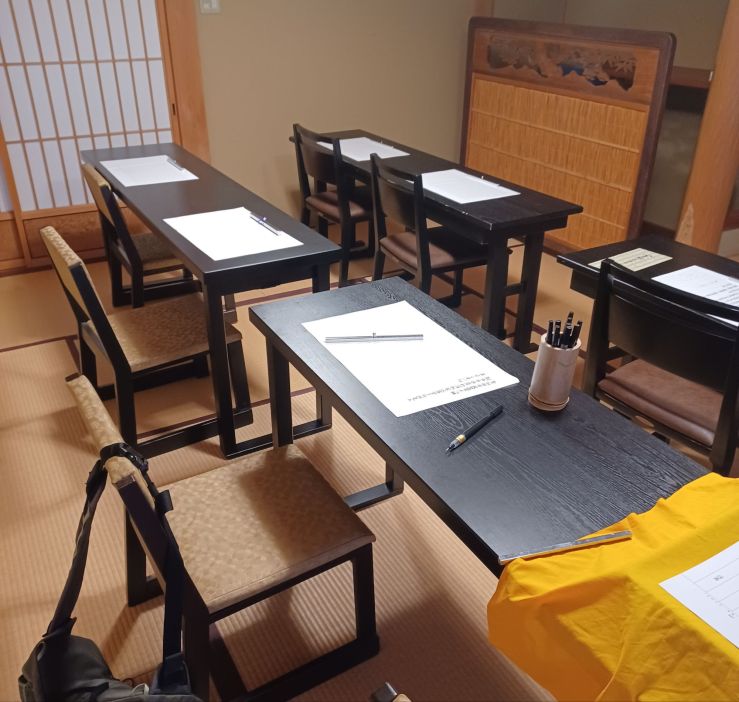
At first I sat, trying to copy. In a sense, this is easy because the Chinese/Japanese characters are beneath the thin sheet of paper on which the copying is done. It is basically just tracing. Still, these characters are not so simple as these letters.
I stood to be able to hold the “pen” upright to better trace the characters. My tracing, I thought, only barely mimicked the characters beneath my thin sheet of paper. I kept at it in the cold room, just me, a piece of paper, a jar of pens, and silence. More than an hour went by. No one came by to see how I was doing.
I finished. I was certain that no one who knew how to read these characters would be able to find any sense in my ink blots.
No one came and I was beginning to get very cold. I wasn’t sure whether it was appropriate for me to go outside the room and try to find my way back to the reception desk. I heard voices outside but no one came to my rescue. Finally, I stepped out just as another monk happened by. I held my ink stained paper before him and managed to make him know that I needed to know what to do next. So good he was! He pointed me the way back to the reception desk and we bowed together, me thanking him for his smile and hospitality.
The original monk was at the desk, greeted me warmly enough, folded my mangled sutra, put it in an envelope, and I paid the donation for my trouble. I have to say that I was thrilled to have been able to complete this task.
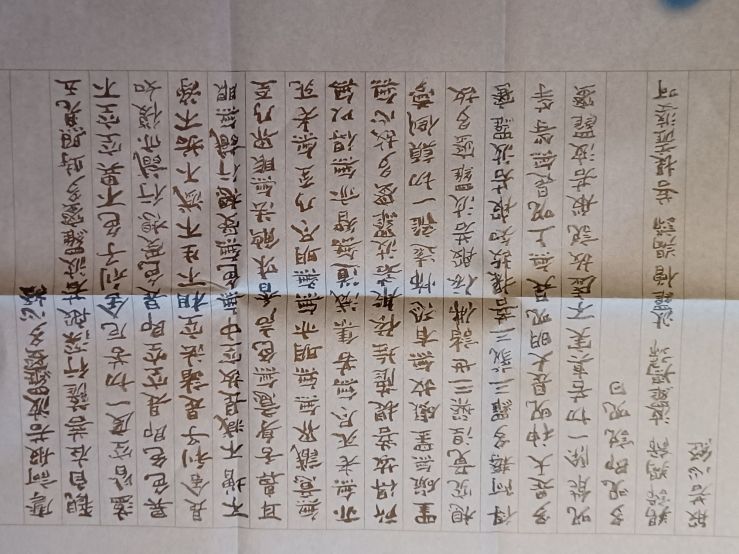
This is my copy. I scanned it with the Google Translate function and it seemed to be able to read it. While it does not read quite as we recite it in our Seattle sangha, the gist of it comes through.
The Heart Sutra is like a brief summation of Buddhism. I can’t explain it because I am only at the faintest beginnings of understanding what it means. It is, however, one of those things where, while you can’t explain it and do not understand it, you sense it is true.
Now, back to Avalokiteshvara. In the Heart sutra, Avalokitishvara is one of the characters, along with Shariputra. How Avalokitishvara received his knowledge to pass on to Shariputra, and to us, is not known. At least that is what I got from Red Pine, a translator of Chinese texts. Somewhere in my copied version of the Heart Sutra, I hope to find the names of both Avalokiteshvara and Shariputra.
Other monasteries offer copying to guests. I am grateful that I was able to complete this at Kosho-ji.
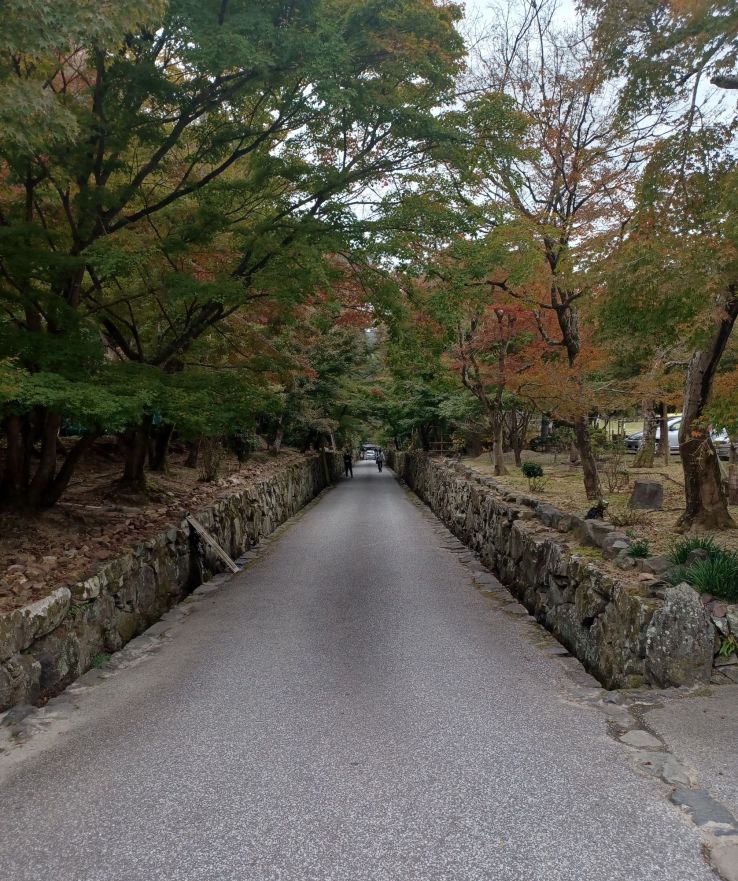
The long uphill/downhill to the gate of Kosho-ji.
 Autumn In Japan