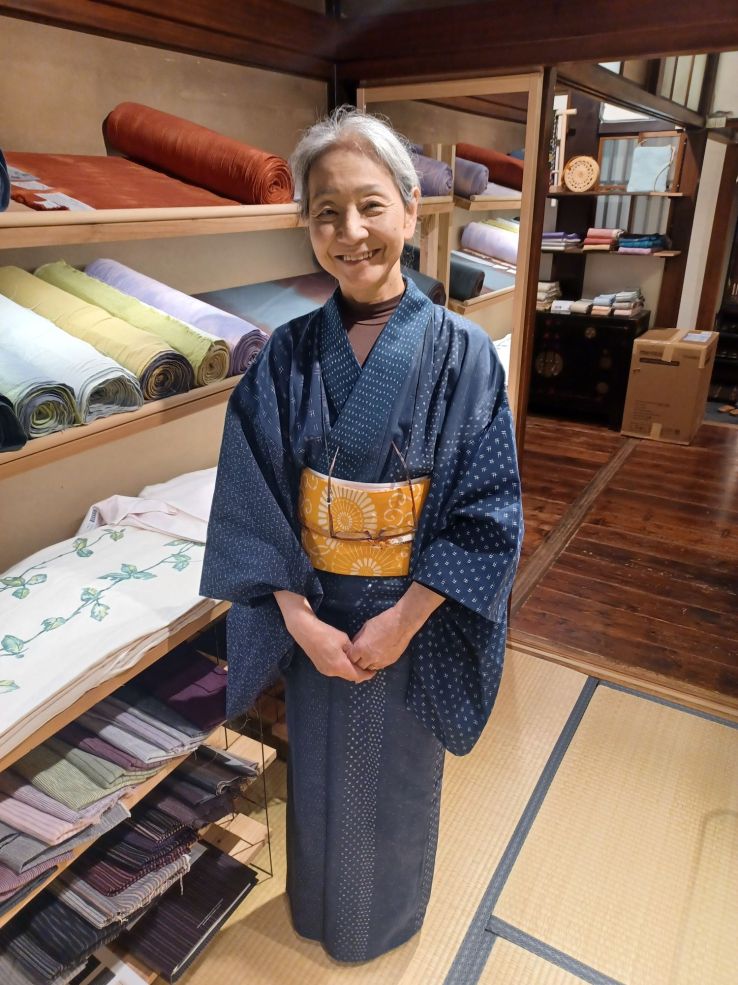
This is Kyoko. Her shop specializes in kimono. She custom makes kimono, tailored to fit each of her clients using materials and designs of their choosing.
As nice as Kyoko proved to be, I believe she looked askance at me when I walked into her shop. I suspect that the great majority of her clients are both female and Japanese, with the rather bedraggled looking older American male being the rare exception.
I explained as best I could that I was interested in a yukata, not a more formal men’s kimono. A yukata is an informal outer type of bathrobe, used after bathing or for seasonal wear around the home. I first became acquainted with yukata when in Fukui at what was a spa type accomodation. People wore them everywhere, including in the dining area and outside. The accomodation provided them for all their guests. I tried mine and liked it very much! I knew immediately that to have one would be one of the “souvenirs” I’d like to bring back with me.
I waited on trying to find one until I got to Kyoto because I didn’t want to lug souvenirs all over Japan with me. So, day one in Kyoto, I looked up where to find one that was other than a department store variety. Kyoko’s shop, Ochicochiya, popped up and it wasn’t far from where I was doing my search.
Kyoko quickly enough began to understand that I was serious about this and began talking about materials and colors. I made my decisions. I wanted the three seasons material that, while it came in a variety of patterns, came only in shades of indigo. While not a “blue” person, I chose a deep indigo cloth. The indigo dye is a Japanese dye, and, as I wished to have an “authentic” Japanese yukata, this was the right choice for me.
Next began the measuring process. Length of arms, around the hips, centerline from mid-back. This was my first “bespoke” process and most certainly my last. Then, I chose a waist band. These are made from leftover material, such as a rag rug would be. Kyoko assured me that this, too, was traditionally Japanese, coming out of the Edo period.
Following this, it came time to pay up. This was a more complicated process than I was able to understand. Kyoko called in two associates to figure it out. I enjoyed watching as they weighed the cloth materials on a small scale, carefully balancing them. While they were at it I went out to sit in their beautiful Japanese garden.
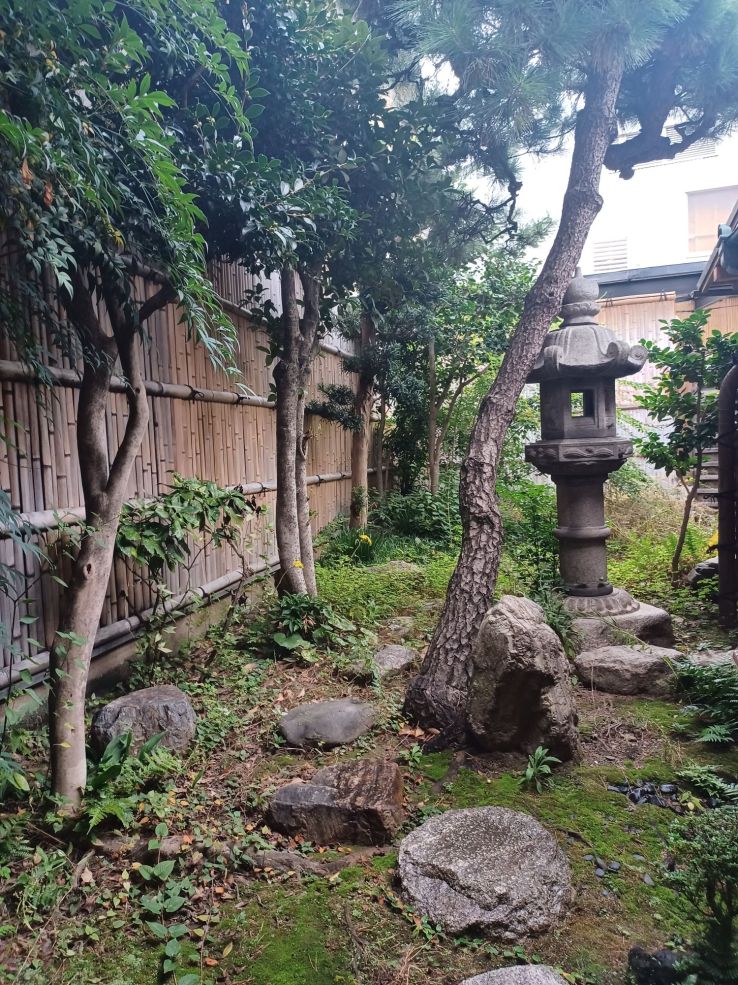
In two months, I will receive, in Seattle, my “souvenir” from Japan. This was an extravagant purchase, indeed, but this whole trip has been an extravagance, so why stop now?
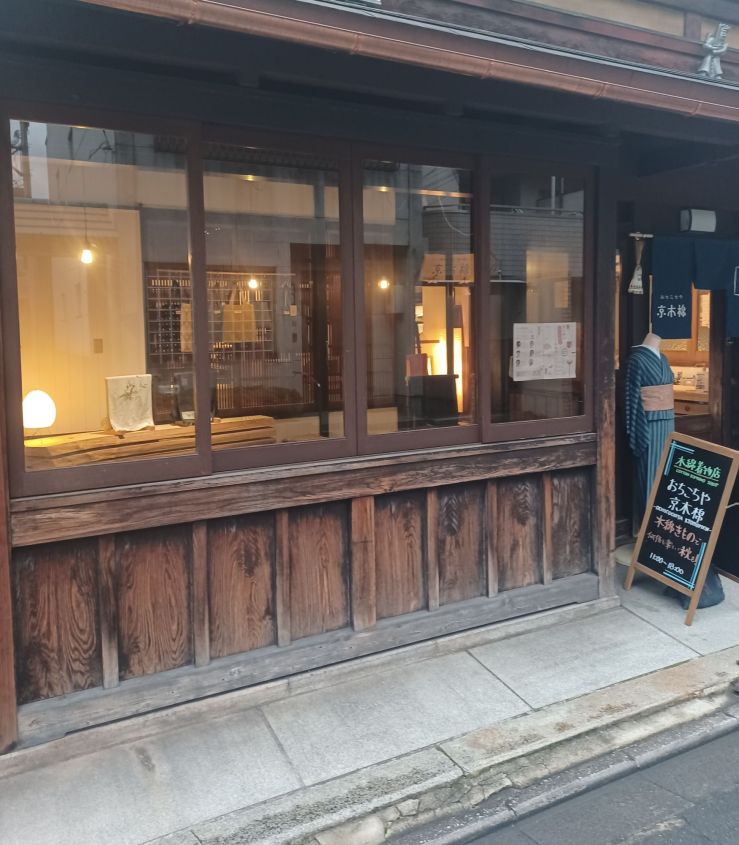
Kyoko’s shop, Ochicochiya, in Kyoto. I am very glad to have made her acquaintance! The authenticity of the place, the materials, and the person of Kyoko, was a delightful experience for me!
 Autumn In Japan
Carol in yukata that came with the ryokan where we stayed near Ponto-cho, Gion, Kyoto.
Sent from Gmail Mobile
LikeLiked by 1 person
The pictures you are trying to send are not coming through. I don’t know why. I’d love see this one. I believe we saw Carol’s kimono when we visited but not her wearing it. I am staying near the Ponto-cho and walked it yesterday. I need to go back at night.
LikeLike