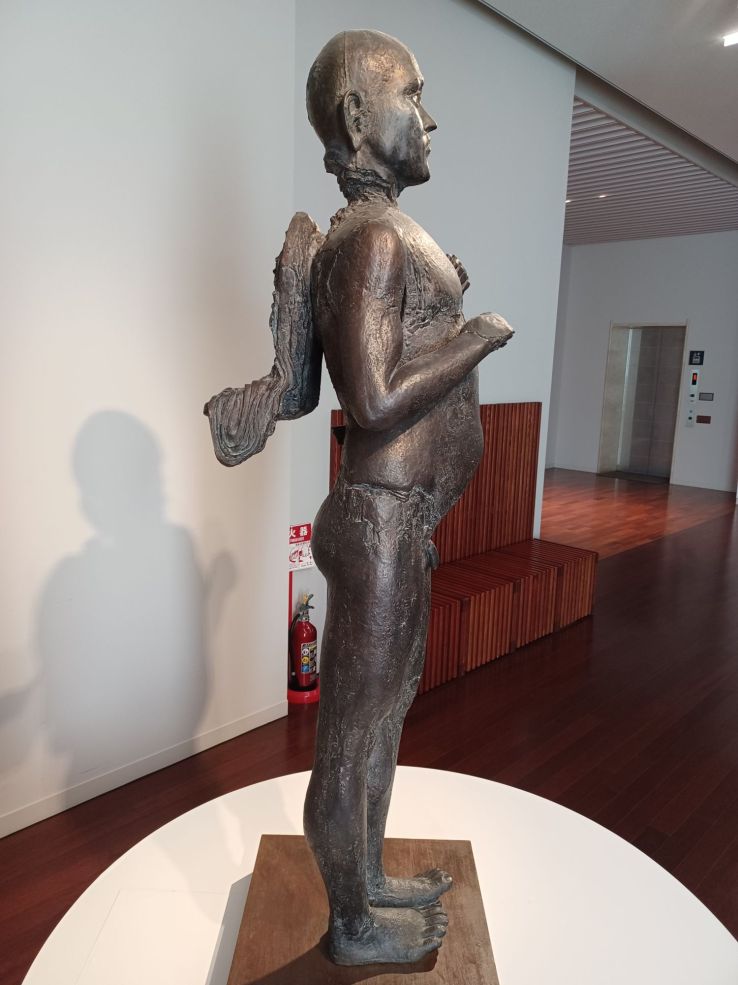
I feel certain that my Zen brothers and sisters will appreciate this rather unusual view of Master Dogen, perhaps the last sight I might have expected to encounter in Japan or anywhere else in the world for that matter.
For those not acquainted with him, Dogen was a Japanese Buddhist monk who, after some years in China, brought back to Japan the understanding of Zen as we practice it now. His was a towering intellect revealed in voluminous writings, often incomprehensible in translation. These were informed by his rigorous sitting practice (zazen) and a profound enlightenment experience. The Japanese Soto Zen tradition comes from Master Dogen. Near Fukui, where I am off to today, he founded Eihei-ji monastery in 1244. It is the principal center of Soto Zen Buddhism in Japan, or the world. More to come on that later.
Perhaps this provides enough context for the unusual presentation of Dogen that I encountered in the Matsumoto Museum of Art, as envisioned by Matsumoto born artist, Hosokawa Munehide.
It is interesting to try to imagine why the artist chose Dogen as a sculpture subject, one of several in his “Man and Woman “series. Of these, only the sculpture of Dogen is shown in the museum.
Apparently, the artist’s intent was, so to speak, “strip” the subjects of the veneer created by history and imagination, and present them in their most natural form. Here is Hosokawa Munehide’s interpretive sculpture of Zen Master Dogen, one of the most revered figures in Japans history. (Bronze with glass eyes.)


 Autumn In Japan